

I’d be happy to check you in.
Some years ago, on a business trip, I checked into a hotel that had just implemented a new computer system. I asked the desk clerk how he liked it. He responded very positively: “It’s great. It’s so much better than the previous system.” He smiled broadly and spoke enthusiastically. I assumed that he was telling the truth.
I also noticed some telling details. He had to bend far forward to reach the keyboard. Then he had to tilt his head back to see the screen. It looked awkward to say the least. He couldn’t make eye contact with me and use the system at the same time.
More problematically, the system was rigid and field-oriented. The screen contained many fields, not all of which were necessary for each client. But you couldn’t skip a field. To get from Field A to Field Z, you had to navigate sequentially through Field B, then Field C, and so on. The poor guy must have hit the Return key a dozen times while checking me in. He couldn’t check me in and have a friendly conversation at the same time.
I noted two things about the situation. First, the man seemed genuinely pleased with the new system. He recommended it without reservation. (No pun intended). Second, the system really wasn’t very good. The man didn’t realize what he might have had.
I also thought about how I might act if I were an executive at the hotel company. If I listened to what the desk clerk said, I would congratulate the IT department, maybe give out a bonus or two, and move on to the next problem.
But if I looked instead of listening, I might have had a very different reaction. The system was awkward, physically uncomfortable, and not conducive to good customer communication. I might not have torn the system out, but I certainly would have requested an upgrade.
This is a pretty good illustration of the difference between seeing with your mind and seeing with your eyes. The desk clerk was seeing with his mind. He had a mental image of the old system (“clunky, user hostile”) and of the new system (“much improved”). He didn’t see what he was actually doing. He didn’t perceive any shortcomings because he was comparing it, not to an ideal system, but to an old system.
A good observer, on the other hand, would not compare the system to preconceived notions. A good observer would have no preconceived notions. She would merely observe and identify problems and opportunities.
My experience reminds me of the women who designed the Volvo concept car some years ago. If I were designing a car, I would assume that it “should” have a hood (bonnet) that opens. After all, all cars have hoods that open. There must be a reason. That’s a notion that I see in my mind’s eye, not in my physical eye.
The Volvo designers, on the other hand, simply observed how people used their cars. They noted that drivers rarely open the hoods. Indeed, they do so only to add windshield washer fluid. The designers asked a simple question: Why bother? They put a fluid filler opening on the outside of the car and simplified the entire front end of the car by eliminating the openable hood.
The designers created a car that is simpler, cleaner, lighter, and stronger. That’s good design. It comes from seeing the world as it is, not as it’s assumed to be.
Designers.
I learned systems analysis in graduate school. I know how to use analytic tools to break a problem apart and fix the component parts. That is, I know how to use the tools if and only if I know that a problem exists. In most cases, somebody has to describe the problem to me.
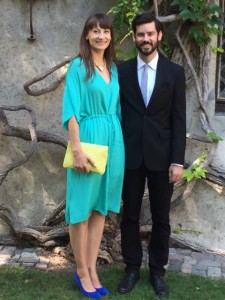
Julia and Elliot, our son and daughter-in-law, learned design thinking in graduate school. They know how to observe closely and intuit what users need. They empathize and can see the world from the user’s perspective. They know how to suspend their assumptions and see the world as it is, not as it’s assumed to be. Paraphrasing Picasso, they see with their eyes, not their minds.
They also have the skills, of course, to design solutions to meet the user’s needs. They can even design solutions for problems that weren’t apparent to the user. Because of the way they observe the world, Julia and Elliot can identify problems and needs that I can’t.
Businesses are starting to realize that design thinking holds significant advantages over traditional methods of systems analysis. Design thinking is an observational skill as much as an analytical skill. It uses empathy and imagination to understand the world at a deeper level and design unexpected solutions.
What does it mean to be design-driven? McKinsey gives a simple definition: “…it’s a way of thinking: a creative process that spans entire organizations, driven by the desire to better understand and meet consumer needs.” For me, it’s not only a way of thinking but also a way of seeing. Designers see what the customer really needs, even if the customer doesn’t.
In this regard, design thinking seems similar to the art of negotiation. A successful negotiator sees what the other side needs — even when the other side doesn’t. The negotiator negotiates to that need. The designer designs to it.
In another article, McKinsey expands the definition and states a key benefit: “A design-driven organization is always thinking about its customers, empathizing with end users, and trying to solve problems while keeping its customers in mind. … Companies that have placed design at the center of the organization perform better.” (Italics added).
Design, in other words, provides a competitive edge. When I was fresh out of school, systems thinking was a competitive weapon. Today, it’s design thinking. Design used to be about things, objects, and spaces. Today, it can equally be used to create business processes and services.
The business world seems to be making a fundamental transition from analysis to design. Instead of decomposing a problem, innovative businesses are using imagination and empathy to create solutions. Julia and Elliot, in other words, have positioned themselves at the leading edge of a transformational new wave. What a great time to be young.

It’s the reminiscence bump.
If you ask someone over the age of thirty to tell you their life story, they’ll over-emphasize some portions and under-emphasize others. Most likely they’ll recall incidents in their late teens and early twenties much more vividly than other periods of their lives. What happens in our thirties stays in our thirties. What happens in our formative years stays with us forever.
It’s known as the reminiscence bump and social scientists have been researching it since the early 1980s. Activities and events that occur in late adolescence and early adulthood leave an indelible mark on our memories. As Katy Waldman puts it, …”there is something deeply, weirdly meaningful about this period.”
Nobody knows quite why the reminiscence bump occurs. Dan McAdams, writing in the Review of General Psychology, associates it with the formation of identity. As we enter adolescence, many different identities are available to us. We could become nerds. Or athletes. Or scholars. Or criminals (especially those with low heart rates). As McAdams points out, William James called this the “one-in-many-selves paradox”.
Yet we generally emerge from adolescence with one more-or-less integrated identity. We want that identity to be coherent. Indeed, there are multiple types of coherent, including biographical coherence, causal coherence, thematic coherence, and temporal coherence. McAdams surmises that integrating multiple potential stories into one coherent identity is a formative life experience that creates long lasting memories.
The articles I’ve read focus on what causes the reminiscence bump. I’m also interested in what the reminiscence bump causes. We believe that the bump is universal; we all have it. Does the fact that we remember our formative years better than other years affect our behavior in later life?
I’ve written previously about the availability bias. As Daniel Kahneman has pointed out, humans are not naturally good at statistics. We have difficulty answering questions dealing with probability. So we substitute a simpler question and answer it.
For instance, let’s say someone asks us, “How likely is it that someone will burglarize your house while you’re away for the weekend?” We have no idea what the probabilities are or even how to calculate them. So we answer a simpler question: “How easy is it for me to remember stories of friends’ houses being burglarized?” If it’s easy to remember such stories, we estimate that the probability is high. If it’s difficult, we estimate that the probability is low. (This is sometimes known as the vividness bias – vivid events are easy to recall from memory).
What events are easy for us to recall from our life histories? Compared to all other events, the reminiscence bump suggests that events from adolescence and early adulthood are easiest to recall. The availability bias suggests that we will overestimate the probability that similar events will happen in the future. We can recall them easily. Therefore, we assume they’re highly probable to recur.
Now, consider the adolescent brain. According to the National Institute of Mental Health, it’s “…still under construction.” We tend to engage in riskier behaviors in our teenage years because our executive function is not fully developed. As most of us can well remember, we do stupid things.
What do we disproportionately remember about our lives? The risky and thoughtless behaviors of our formative years. If the availability bias is correct, we will overestimate the probability that these same behaviors will occur again, perhaps in our children. Could this be the root cause of the helicopter parenting that we seem so worried about today? It’s a complicated question but it’s certainly worth a good research project.

My brain thinks it so it must be true.
I don’t consider myself a curmudgeon. But every now and then my System 1 takes off on a rant that is entirely irrational. It’s also subconscious so I don’t even know it’s happening.
My System 1 wants to create a continuous story of how I interact with the world. Sometimes the story unfolds rationally. I use solid evidence to create a story that flows logically from premise to conclusion.
Sometimes, however, there’s no solid evidence available. Does that stop my System 1 from concocting a story? Of course not. I simply make up a story out of whole cloth. The story may well be consistent in its internal details but may also be entirely fictional. I use it to satisfy my need for a comforting explanation of the world around me. In this regard, it’s no different from a child’s bedtime story.
Though I refer to it as System 1, it’s actually my left brain interpreter that does the work. According to Wikipedia, “…the left brain interpreter refers to the construction of explanations by the left brain in order to make sense of the world by reconciling new information with what was known before. … In reconciling the past and the present, the left brain interpreter may confer a sense of comfort to a person, by providing a feeling of consistency and continuity in the world. This may in turn produce feelings of security that the person knows how “things will turn out” in the future.”
Apparently, our desire for “feelings of security” is deep and strong. So strong, in fact, that our left brain interpreter may create a “contrived” story even in the absence of facts, data, and evidence. While the interpreter often interprets things logically, it “…may also enhance the opinion of a person about themselves and produce strong biases which prevent the person from seeing themselves in the light of reality.”
How often does the interpreter create completely contrived stories? More often than you might think. In fact, my left brain interpreter took off on a flight of fancy just the other day.
Suellen and I were driving to an event at the University of Denver. We were running a few minutes late. We were on a four-lane boulevard where the speed limit is 30 miles per hour. But most people drive at 40 mph because the road is broad and straight. We got stuck behind a Prius that was driving at precisely the speed limit. Here’s how my left brain interpreted the event:
Damn tree-hugger in a Prius! Thinks he’s superior to the rest of us because he’s saving the planet. He wants to keep the rest of us in line too, so he’s driving the speed limit to make sure that we behave ourselves. What a jerk! Who does he think he is? Doesn’t he know it’s rush hour? What gives him the right to drive slowly?
That’s a pretty good rant. But it has nothing to do with reality. I didn’t know anything about the driver but I still created a story to connect the dots. The story followed a simple arc: he’s a jerk and I’m an innocent victim. It’s simple. It’s internally consistent. It enhances my opinion about myself. And it’s completely fictional.
How did I know that I was ranting? Because I interrupted my own train of thought. When I thought about my thinking – and brought the story into my conscious mind – I realized it was ridiculous. It wasn’t his fault that I was running late. And who, after all, was trying to break the law? Not him but me.
I was certainly thinking like a curmudgeon. I suspect that we all do from time to time. I stopped being a curmudgeon only when I realized that I needed to think about my thinking. Curmudgeons may well think primarily with their left brain interpreter. Whatever story the interpreter concocts becomes their version of reality. They don’t think about their thinking.
When we’re with someone who is lost in thought, we might say, “A penny for your thoughts.” It’s a useful phrase that often starts a meaningful conversation. We might make it more useful by altering the wording. To avoid being a curmudgeon, we need to think about our thinking. Perhaps we should simply say, “A penny for my thoughts.”

Architect or burglar?
Long-time readers of this column know that I’m an advocate of mashup thinking. You take an idea from Column A and an idea from Column B and mash them together. So, for instance, X-rays (Column A) when mashed up with computerized image processing (Column B), yield an important new product called CT scanners.
A good way to brainstorm is simply to mash up ideas from different categories. You’re not thinking out of the box. Rather you’re thinking out of multiple boxes. What would you get if you mashed up, say paper with pasta? Would it be edible paper? Or maybe pasta that you could print messages on? Would it be useful? Maybe. Maybe not. What’s useful is the process of getting there.
So, I was delighted to see that the Museum of Contemporary Art (MCA) in Denver has started a program called Mixed Taste. MCA describes the program as Tag Team Lectures On Unrelated Topics. The idea is simple – they choose two topics (seemingly out of thin air) that are completely unrelated. Then they get speakers to speak on each topic. They rent an auditorium, get a band, invite the public, and have at it.
Last night, the topics were rabies and burglary. I thought of these as two completely unrelated topics but, when you mash them up, you get some surprises. And that’s the point.
At the event, Monica Murphy and Bill Wasik spoke first. They’re good Brooklynites and also the authors of Rabid: A Cultural History of the World’s Most Diabolical Virus. Here are some things you might not know about rabies.
Geoff Manaugh, an architect who created the popular BLDG|BLOG, spoke next. Manaugh also has a book that will launch next spring called, A Burglar’s Guide To The City. Manaugh pointed out that architects are enablers of burglars. Burglars couldn’t operate without built environments. Architects may think they’re building useful or inspiring structures but they’re also creating a playground for burglars. A good burglar can identify patterns in buildings and use them to locate vulnerabilities. Burglars are often avid students of architectural codes.
So what’s the similarity here? The one I took away is this: Burglars are to buildings as rabies is to humans. Here are some similarities:
I never would have thought of these similarities if MCA hadn’t mashed them up for me. I found it fascinating. But is any of it practical or useful? I’m not sure … but perhaps we can adapt the techniques we use to control viruses to also control burglars (or vice-versa). But even if that’s not the outcome, we’re practicing the art of mashups — an intriguing thinking process that can produce surprising insights and innovations. For that, I thank the MCA.
(By the way, Monica Murphy, Bill Wasik, and Geoff Manaugh are all very good speakers and I recommend them highly to you).


