

Relax Elliot. It’s just a birdie.
Last week, I tweeted about the ability of golfers to make putts under different conditions. I claimed that even the best golfers have a loss aversion bias. Therefore, they’re more accurate when putting for par than for birdie. If they miss a par putt, they wind up with a bogey — a painful experience. If they miss a birdie, on the other hand, they often get a par — not so bad. The pain of getting a bogey is greater than the pleasure of getting a birdie. That’s pretty much the definition of the loss aversion bias.
Several of my friends who are golfers suggested that I don’t know what I’m talking about. For instance, my buddy Nick Gomersall wrote, “When you putt for a birdie you are more relaxed, nothing to lose and you stroke it in. Now when you putt for par you have negative thoughts as you think what happens if you miss and you put a bad stroke on it.” Nick is an excellent golfer and an all-round good guy but he’s wrong.
Here’s a link to a 2009 article on the topic, “Avoiding the Agony of a ‘Bogey”: Loss Aversion in Golf — and Business“. The authors, Devin Pope and Maurice Schweitzer, gathered data on 2.5 million putts taken in 239 PGA tournaments between 2004 and 2009. They note that “par” is an excellent divider between gain and loss. Better-than-par is a gain; worse-than-par is a loss. Loss aversion theory says losses are felt more deeply than gains. Thus, a bogey should bring more pain than a birdie brings pleasure. A golfer should try harder to avoid a bogey than to achieve a birdie.
And, that’s exactly what happens. The authors conclude, “…on average, golfers make their birdie putts approximately two percentage points less often than they make comparable par putts. This finding is consistent with loss aversion; players invest more focus when putting for par to avoid encoding a loss ….” Pope and Schweitzer used a number of statistical analyses to control for variables such as distance from the hole, the player’s overall skill, confidence, nervousness, and so on. The only explanation seems to be loss aversion.
Loss aversion is essentially an illogical bias. Why does it occur? According to Schweitzer, “”Loss aversion is the systematic mistake of segregating gains and losses — evaluating decisions in isolation rather than in the aggregate — and over-weighting losses relative to gains…”
Golf, it seems, can teach us a lot about business and finance. To avoid loss aversion, you need to look at the big picture. In golf, that means your position in the tournament rather than your position on the green. In investing, that may mean focusing on your entire portfolio rather than the gains or losses of an individual stock on an individual day. As Monty Python points out, “Always look on the bright side of life.”

Don’t feel blue. Do the stiletto workout.
Did you know that we’ve had 13 full moons in 2012? We had a blue moon in August. We’ll have another blue moon in about three years. What does that have to do with anything? Well, not much except that it’s the end of the year and I’m feeling a bit moony. Hope you have a good year in 2013. Here are some interesting things to read along the way.
Do bacteria cause obesity? We used to think that stress caused ulcers. Then we learned that it’s really a virus. Today, we believe that obesity is caused by overeating and lack of control. It’s a cultural issue or a psychological issue. But what if it’s just a bacteria? That’s the upshot of new research reported here. Maybe people get fat because of what’s in their gut rather than what’s in their brain.
It takes twenty years to build a reputation and twenty minutes to wreck it. Daniel Diermier probably knows more about reputation as a corproate asset than all the rest of us put together. Here’s what he says are the top ten reputational disasters of 2012. Be glad you’re not on the list.
So, your reputation suffers a disaster. What can you do about it? Well, the first thing is to learn how to apologize gracefully and completely. Here are some good and not-so-good ways to apologize to your customers. Though it doesn’t get much practice, Apple seems to lead the way in this category as well.
I’m about to teach a class on critical thinking so I was excited to find that Stephen Colbert has already recorded an excellent primer on critical thinking in Texas. You can find it here.
And for critical thinking about the future, here are five technologies to watch in 2013.
Enough about disasters and apologies. Here’s some good news. The global infant mortality rate has dropped from 88 deaths per 1,000 live births in 1990 to 57 deaths per 1,000 in 2010. That’s a decline of slightly more than 35%. It’s also an indication that numerous health care innovations are creating an important impact. Read about it here.
Finally, just in case you’re worried about staying in shape for the new year, here’s the stiletto workout. Feel the burn!

Power differential.
Remember heuristics? They’re the rules of thumb that allow us to make snap judgments, using System 1, our fast, automatic, and ever-on thinking system. They can also lead us into errors. According to psychologists there are least 17 errors that we commonly make. In previous articles, I’ve written about seven of them (click here and here). Let’s look at four more today.
Association — word association games are a lot of fun. (Actually, words are a lot of fun). But making associations and then drawing conclusions from them can get you into trouble. You say tomato and I think of the time I ate a tomato salad and got sick. I’m not going to do that again. That’s not good hygiene or good logic. The upside is that word associations can lead you to some creative thinking. You can make connections that you might otherwise have missed. And, as we all know, connections are the foundation of innovation. Just be careful about drawing conclusions.
Power differential — did you ever work for a boss with a powerful personality? Then you know something about this heuristic. Socially and politically, it may be easier to accept an argument made by a “superior authority” than it is to oppose it. It’s natural. We tend to defer to those who have more power or prestige than we do. Indeed, there’s an upside here as well. It’s called group harmony. Sometimes you do need to accept your spouse’s preferences even if they differ from yours. The trick is to recognize when preferences are merely a matter of taste versus preferences that can have significant negative results. As Thomas Jefferson said, “On matters of style, swim with the current. On matters of principle, stand like a rock”.
Illusion of control — how much control do you really have over processes and people at your office? It’s probably a lot less than you think. I’ve worked with executives who think they’ve solved a problem just because they’ve given one good speech. A good speech can help but it’s usually just one step in a long chain of activities. Here’s a tip for spotting other people who have an illusion of control. They say I much more often than we. It’s poor communication and one of the worst mistakes you can make in a job interview. (Click here for more).
Loss and risk aversion — let’s just keep doing what we’re doing. Let’s not change things … we might be worse off. Why take risks? It happens that risk aversion has a much bigger influence on economic decisions than we once thought. In Thinking Fast and Slow, Daniel Kahneman writes about our unbalanced logic when considering gain versus loss — we fear loss more than we’re attracted by gain. In general terms, the pain of a loss is about double the pleasure of a gain. So, emotionally, it takes a $200 gain to balance a $100 loss. Making 2-to-1 decisions may be good for your nerves but it often means that you’ll pass up good economic opportunities.
To prepare this article, I drew primarily on Peter Facione’s Think Critically. (Click here) Daniel Kahneman’s book is here.
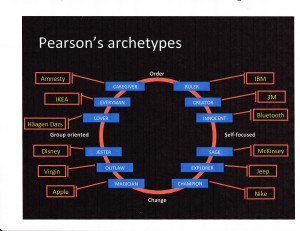 As you develop your company’s brand, how do you determine what “personality” you should project? How do you know where your brand fits relative to other brands in the market? I always recommend that you do as much market research as you can. I also recommend that you study the archetypal systems developed by Carol Pearson (whose website is here).
Pearson is a Jungian psychologist more than a marketing maven. She has developed a set of archetypes that help people understand how to use their inner resources to enrich their lives. Fortunately for us marketing types, these archetypes can also be applied to companies and organizations. They can help you understand how you fit into a broader ecosystem and how to convey your message most effectively.
When I worked at Lawson Software, we used the simplified diagram that you see here. The diagram includes 12 basic archetypes with a company to illustrate each one.
The circle helps you understand how the archetypes fit together. For instance, note the word “Order” at the top of the circle and the word “Change” at the bottom. Simply put, the companies on the top half of the circle want to maintain the existing order, the current market structure. By comparison, the companies on the bottom half might be described as “upstarts”. They want to change — or overthrow — the current market structure.
The left and right halves of the circle also have much to tell us. The archetypes on the left side are group-oriented. Those on the right side are more self-focused. The simplest explanation is that those companies on the left of the circle focus primarily on their external constituencies. Those on the right focus more attention on internal processes and procedures.
At Lawson, we quickly decided that we were on the bottom half of the circle. We weren’t the market leaders, we didn’t dominate the segment — we needed to shake things up to find our place in the sun. Similarly, we decided that we were on the left side of the circle. We were market oriented and our mission was to make our customers stronger. In other words, we were externally focused.
So, we were on the lower left segment of the circle. We had three archetypes to choose from: 1) Jester, like Disney; 2) Outlaw, like Virgin; 3) Magician, like Apple. We then proceeded by elimination. We were a B2B company and just didn’t have the magical chops of Apple. Similarly, we weren’t a jester like Disney. Indeed, we were probably too serious.
That left us at “Outlaw”. We never really liked that label but ultimately we decided that’s who we were. (We described ourselves as “disrupters” rather than as “outlaws” but, really, what’s the difference?) To succeed, we needed to break some rules. We needed to be different and shake things up. It helped that we had a plain-spoken and charismatic CEO who was not unlike Richard Branson.
Choosing the outlaw/disrupter path almost immediately led us to use a cartoon character — very different than what you would expect from, say Oracle or SAP. With help from Fiftyeight, a very creative agency in Germany, we developed the Lars Lawson character as well as Sepp (for SAP) and ElCaro (Oracle spelled backwards). We then launched a series of video adventures on YouTube that typically garnered over a million views. (You can see the most popular videos here and here).
Did it work? You betcha. We grew faster than our segment and gained visibility globally. Bottom line: whether you’re a person or a company, it helps to know who you are and where you fit.
You can find Carol Pearson’s books here.

Just five more steps.
How does creativity happen? Is there a pattern — more or less standard — that we can repeat? Is there a process that can lead us from ordinary beginnings to extraordinary ends? Mihaly Csikszentmihalyi — while not guarateeing results — writes that creativity typically evolves through five stages.
The first stage is preparation. Basically, you need to know the rules before you break them. Thomas Kuhn writes that scientific paradigms reflect a basic consensus of how the world operates. Prior to Copernicus, the astronomical paradigm held that the earth was the center of the universe. Before Copernicus could change the paradigm, he had to immerse himself in it. Only then could he make the observations that changed the paradigm.
The second phase is incubation, “… during which ideas churn around below the threshold of consciousness.” This is when I like to go for a walk. I like to lay things aside, clear my head, and let my mind wander. It’s a haphazard process — sometimes nothing happens. Sometimes I simply forget what I was thinking about. Other times, however, something bubbles up that’s worth capturing. (One of the reasons I write this blog is to double back on my own thinking, recall what I wrote months ago, and perhaps make connections I would otherwise miss).
Third, is the insight — the Aha moment. As we saw in the article on sleepiness and creativity (click here), focusing intently on the problem at hand may actually inhibit the Aha experience. When you focus, you block out random thoughts and stray ideas. But it’s those very thoughts and ideas that may produce the insight. When you’re tired — or when you can induce your mind to wander — those stray thoughts are not blocked out and can help you see things more creatively.
Fourth is evaluation, “…when the person must decide whether the insight is valuable and worth pursuing.” This is a difficult step. You think you’ve had a brilliant flash of insight … you start dreaming of a trip to Stockholm to accept a Nobel Prize. On the other hand, maybe it’s just a crackpot idea that your colleagues will laugh at. A thorough understanding of the current paradigm will help. If you’re a master of your discipline, you’ll have a much better idea of which ideas are worth pursuing and which are just goofy.
The fifth step is elaboration. You develop the idea, conduct the research, test your hypotheses, and present your conclusions to your colleagues — who may just rip it apart. As Csikszentmihalyi notes, “This is what Edison was referring to when he said that creativity consists of 1 percent inspiration and 99 percent perspiration.”
Does the five-step process always produce creative innovations? No, not at all. But, if your purpose is to create new ideas, products, and services you should always be cognizant of where you are in the process. Following the process doesn’t guarantee success. But not following it virtually guarantees failure.
You can find Mihaly Csikszentmihalyi’s book here. Thomas Kuhn’s book is here.


