
Several clients have recently asked me to help them craft their vision statements. So, what makes for a good vision statement? Let’s

My vision is improving.
start with a few of my favorites:
Google: To organize the world’s knowledge and make it useful.
Lawson: We make our customers stronger.
University of Denver: A private school dedicated to the public good.
US Air Force: Fly, Fight, and Win.
Denver Public Schools: Every Child Succeeds.
National Multiple Sclerosis Society (NMSS): A World Free of MS
We provide world-class services to hospitals…
So what?
…so that hospitals will be more effective …
So what?
…. so that hospitals can save more lives.

The next mobile app platform?
Some interesting things I spotted this week, whether they were published this week or not.
The Economist asks, will we ever again invent anything that’s as useful as the flush toilet? Is the pace of innovation accelerating or decelerating? And what should we do about it, if anything?
When we think about innovation, we often focus on ideas and creativity. How can we generate more good ideas? But what about the emotional component of innovation? For innovative companies, emotional intelligence may trump technical intelligence. Norbert Alter answers your questions from Paris.
We’re familiar with the platform wars for mobile applications. Will Apple’s iOS become the dominant platform? Or maybe it will be Android from Google? Perhaps it’s some version of Windows? But what if the next great mobile app platform is a Ford or a Chevy? (Click here).
For my friends in Sweden, here’s McKinsey’s take on the future of the Swedish economy. Things are looking up — just don’t rest on your laurels.
Where does America’s R&D money go? Here’s an infographic that shows how the Federal government has invested in research over the past 50 years.
The Greeks had lots of tricks for memorizing things. They could hold huge volumes of information in their heads. But does memory matter anymore? After all, you can always Google it, no? William Klemm writes that there are five reasons why tuning up your memory is still important. And he’s a Texas Aggie so he must be right.

It’s a quality issue.
In his book, Thinking Fast and Slow, Daniel Kahneman has an interesting example of a heuristic bias. Read the description, then answer the question.
Steve is very shy and withdrawn, invariably helpful but with little interest in people or in the world of reality. A meek and tidy soul, he has a need for order and structure, and a passion for detail.
Is Steve more likely to be a librarian or a farmer?
I used this example in my critical thinking class the other night. About two-thirds of the students guessed that Steve is a librarian; one-third said he’s a farmer. As we debated Steve’s profession, the class focused exclusively on the information in the simple description.
Kahneman’s example illustrates two problems with the rules of thumb (heuristics) that are often associated with our System 1 thinking. The first is simply stereotyping. The description fits our widely held stereotype of male librarians. It’s easy to conclude that Steve fits the stereotype. Therefore, he must be a librarian.
The second problem is more subtle — what evidence do we use to draw a conclusion? In the class, no one asked for additional information. (This is partially because I encouraged them to reach a decision quickly. They did what their teacher asked them to do. Not always a good idea.) Rather they used the information that was available. This is often known as the availability bias — we make a decision based on the information that’s readily available to us. As it happens, male farmers in the United States outnumber male librarians by a ratio of about 20 to 1. If my students had asked about this, they might have concluded that Steve is probably a farmer — statistically at least.
The availability bias can get you into big trouble in business. To illustrate, I’ll draw on an example (somewhat paraphrased) from Paul Nutt’s book, Why Decisions Fail.
Peca Products is locked in a fierce competitive battle with its archrival, Frangro Enterprises. Peca has lost 4% market share over the past three quarters. Frangro has added 4% in the same period. A board member at Peca — a seasoned and respected business veteran — grows alarmed and concludes that Peca has a quality problem. She sends memos to the executive team saying, “We have to solve our quality problem and we have to do it now!” The executive team starts chasing down the quality issues.
The Peca Products executive team is falling into the availability trap. Because someone who is known to be smart and savvy and experienced says the company has a quality problem, the executives believe that the company has a quality problem. But what if it’s a customer service problem? Or a logistics problem? Peca’s executives may well be solving exactly the wrong problem. No one stopped to ask for additional information. Rather, they relied on the available information. After all, it came from a trusted source.
So, what to do? The first thing to remember in making any significant decision is to ask questions. It’s not enough to ask questions about the information you have. You also need to seek out additional information. Questioning also allows you to challenge a superior in a politically acceptable manner. Rather than saying “you’re wrong!” (and maybe getting fired), you can ask, “Why do you think that? What leads you to believe that we have a quality problem?” Proverbs says that “a gentle answer turneth away wrath”. So does an insightful question.
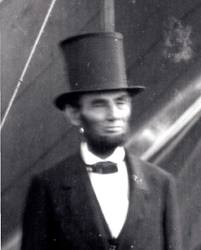
My speech is under my hat.
On July 4, 1863, Robert E. Lee was leading a Confederate army in retreat from Gettysburg when they were trapped against the rain-swollen Potomac River. The Union army, commanded by General George Meade, pursued the rebels. Abraham Lincoln ordered Meade to attack immediately. Instead, Meade dithered, the weather cleared, the river shrank, and Lee and his army escaped. Lincoln was furious and penned this letter to Meade:
I do not believe you appreciate the magnitude of the misfortune involved in Lee’s escape. He was within our easy grasp, and to have closed upon him would, in connection with our other late successes, have ended the war. As it is, the war will be prolonged indefinitely. If you could not safely attack Lee last Monday, how can you possibly do so south of the river, when you can take with you very few— no more than two-thirds of the force you then had in hand? It would be unreasonable to expect and I do not expect that you can now effect much. Your golden opportunity is gone, and I am distressed immeasurably because of it.
Interestingly, Lincoln never sent the letter — it was found among his papers after his death. Lincoln generally praised his colleagues for their positive accomplishments and said little or nothing about their failures. Apparently, he wrote letters like the one to Meade to relieve his own frustrations — and perhaps to leave a record for history — rather than to humiliate his colleagues and create public acrimony.
As Douglas Wilson, a Lincoln scholar, pointed out in a recent article (click here), Lincoln was great communicator but not necessarily in the way we think. Some tidbits on how he worked:
Lincoln has always been one of my favorite presidents and I certainly enjoyed the recent movie from Steven Spielberg. Lincoln communicated effectively and was an expert at shaping public opinion. As the movie showed, he was also adept at cutting deals and rolling logs to achieve his greater goals. Not bad for a kid from the prairies.

The future is behind you.
When I’m happy, I smile. A few years ago, I discovered that the reverse is also true: when I smile, I get happy. I’ve also found that standing up straight — as opposed to slouching — can improve my mood and perhaps even my productivity.
It turns out that I was on to something much bigger than I realized at the time. There’s increasing evidence that we think with our bodies as well as our minds. Some of the evidence is simply the way we express our thoughts through physical metaphors. For instance, “I’m in over my head”, “I’m up to my neck in trouble”, “He’s my right hand man”, and so on. Because we use bodily metaphors to express our mental condition, the field of “body thinking” is often referred to a metaphor theory. Perhaps more generally, it’s called embodied cognition.
In experiments reported in New Scientist and in Scientific American, we can see some interesting effects. For instance, with people from western cultures, “up” and “right” mean bigger or better while “down” or “left” mean smaller or worse. So, for instance, when volunteers were asked to call out random numbers to the beat of a metronome, their eyes moved upward when the next number was larger and moved downward when the next number was smaller. Similarly, volunteers were asked to gauge the number of objects in a container. When they were asked to lean to the left while formulating their estimate, they guessed smaller numbers on average. When leaning to the right, they guessed larger numbers.
In another experiment, volunteers were asked to move boxes either: 1) from a lower shelf to a higher shelf; or 2) from a higher shelf to a lower shelf. While moving the boxes, they were asked a simple, open-ended question, like: What were you doing yesterday? Those who were moving the boxes upward were more likely to report positive experiences. Those who were moving the boxes downward were more likely to report negative experiences.
When I speak of the future, I often gesture forward — the future is ahead of us. When I speak of the past, I often do the opposite, gesturing back over my shoulder. Interestingly, the Aymara Indians of highlands Bolivia are reported to do the opposite — pointing backward to the future and forward to the past. That seems counter-intuitive to me but the Aymara explain that the future is invisible. You can’t see it. It’s as if it’s behind you where it can quite literally sneak up on you. The past, on the other hand, is entirely visible — it’s spread out in front of you. That makes a lot of sense but my cultural training is so deeply embedded that I find it very hard to point backward to the future. It’s an interesting example of cultural differences influencing embodied cognition.
Where does this leave us? Well, it’s certainly a step away from Descartes’ formulation of the mind-body duality. The body is not simply a sensing instrument that feeds data to the mind. It also feed thoughts and influences our moods in subtle ways. Yet another reason to take good care of your body.


