
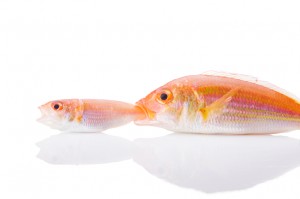
Fish gangs.
Interesting things I’ve spotted this week.
Boston Consulting Group highlights the most innovative companies of 2012. What makes them more innovative than your company?
What makes beautiful things beautiful? What’s the perfect ratio of fractals to non-fractals and how did Jackson Pollock know it? Maybe the secret of beauty is buried in our genes.
The rate of growth in health care costs has slowed dramatically over the past four years. Now why would that be?
Spending on health care construction has also dropped precipitously. See the most important health care chart that nobody is talking about.
Do you flush your Valium down the toilet? You could be causing fish to join gangs and drop out of schools.
What happens to the thermostat when it’s re-designed by the people who designed the iPhone and the iPod?

Make way!
An ambulance, racing to the hospital, siren blaring, approaches an intersection. At the same time, from a different direction, a fire truck, racing to a fire, approaches the same intersection. From a third direction, a police car screeches toward the same intersection, responding to a burglary-in-progress call. From a fourth direction, a U.S. Mail truck trundles along to the same intersection. All four vehicles arrive at the same time at the same intersection controlled by a four-way stop sign. Who has the right of way?
The way I just told this story sets a frame around it that may (or may not) guide your thinking. You can look at the story from inside the frame or outside it. If you look inside the frame, you’ll pursue the internal logic of the story. The three emergency vehicles are all racing to save people — from injury, from fire, or from burglary. Which one of those is the worst case? Which one deserves to go first? It’s a tough call.
On the other hand, you could look at the story outside the frame. Instead of pursuing the internal logic, you look at the structure of the story. Rather than getting drawn into the story, you look at it from a distance. One of the first things you’ll notice is that three of the vehicles belong to the same category — emergency vehicles in full crisis mode. The fourth vehicle is different — it’s a mail truck. Could that be a clue? Indeed it is. The “correct” answer to this somewhat apocryphal story is that the mail truck has the right of way. Why? It’s a federal government vehicle and takes precedence over the other, local government vehicles.
In How Doctors Think, Jerome Groopman describes how doctors think inside the frame. A young woman is diagnosed with anorexia and bulimia. Many years later, she’s doing poorly and losing weight steadily. Her medical file is six inches thick. Each time she visits a new doctor, the medical file precedes her. The new doctor reads it, discovers that she’s bulimic and anorexic and treats her accordingly. Finally, a new doctor sets aside her record, pulls out a blank sheet of paper, looks at the woman and says, “Tell me your story.” In telling her own story, the woman gives important clues that leads to a new diagnosis — she’s gluten-intolerant. The new doctor stepped outside the frame of the medical record and gained valuable insights.
According to Franco Moretti, similar frames exist in literature — they’re called books. Traditional literary analysis demands that you read books and study them very closely. Moretti, an Italian literary scholar, calls this close reading — it’s studying literature inside the frame set by the book. Moretti advocates a different approach that he calls distant reading….”understanding literature not by studying particular texts, but by aggregating and analyzing massive amounts of data.” Only by stepping back and reading ourside the frame, can we understand “…the true scope and nature of literature.”
In each of these examples we have a frame. In the first story, I set the frame for you. It’s a riddle and I was trying to trick you. In the second story, the patient’s medical record creates the frame. In the third, the book sets the frame. In each case, we can enter the frame and study the problem closely or we can step back and observe the structure of the problem. It’s often a good idea to step inside the frame — after all, you usually do want your doctor to read your medical file. But it’s also useful to step outside the frame, where you can find clues that you would never find by studying the internal logic of the problem. In fact, I think this approach can help us understand “big” predictions like the cost of healthcare. More on that next Monday.
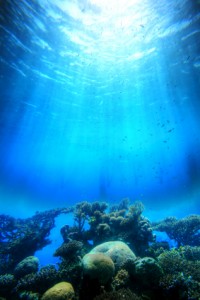
It’s not a reef. It’s a platform.
I’ve spent the past several days in the Minnesota woods at a client’s executive retreat. The client is a software company that has made a number of acquisitions over the past few years. A good portion of the discussion at the retreat focused on how to build a platform that can: 1) integrate the various acquisitions; 2) deliver a common interface; 3) simplify the support load; 4) provide a foundation for developing new functionality more quickly.
The discussion got me thinking about platforms — innovations that generate innovations. I’ve written a lot about innovation over the past year and especially the role of serendipity and mashup thinking. I’ve generally focused, however, on innovations as an end result. In other words, we adopt certain behaviors and modes of thinking and the result is an innovation. We then repeat the process and (hopefully) get another innovation. Creating the innovation essentially ends the process.
Platform thinking, on the other hand, can lead us to innovations that spawn innovations. As Steven Johnson points out, platforms abound in the natural world. Johnson builds an extended metaphor around the coral reef — a platform for unimaginably rich plant and animal life. Once the process gets started (in an otherwise barren sea), the reef builds a virtuous circle that attracts and facilitates multiple life forms. Part of the secret is collaboration. The CO2 that one animal gives off as waste becomes the building block for another animal’s home. Similarly, oxygen is a waste product for some reef denizens but the lifeblood of others.
In the human world, the Internet is probably the best recent example of a platform. The Internet creates both serendipity (we get to meet lots of people) and mashup thinking (we can easily find lots of new ideas to mash together). The Internet also takes care of a lot of the dirty work of information sharing. Just as the coral reef makes it easy for many animals to find a home, the Internet makes it easy for people like me to create websites and share information. We often hear the metaphor of researchers standing on the shoulders of giants. My website is standing on the shoulders of a very rich (and essentially free) technology stack.
Platform thinking is innovation taken to the next step. We think about how to create something that creates something. I’m generally a proponent of free markets, but Johnson makes as strong argument that the most fundamental platforms come from public agencies. Certainly, the Internet did not come from market-driven competition. Rather, it resulted from the collaboration of many specialists from many disciplines in an open environment. That’s pretty much like a coral reef.
So, what’s the next platform? I’m guessing that it’s a mashup of: 1) the human body, 2) secure communications, and 3) Internet sensors. We already have millions of Internet sensors monitoring the environment — everything from air pressure, to ocean salinity, to volcanic pressures. The next frontier could well be sensing human health conditions. We already have wearable condition monitors. For instance, friends of mine run a small company in Denver called Alcohol Monitoring. They provide a wearable device, with secure communications, that alerts probation officers when one of their wards has been drinking. Within a decade, I’d guess that health condition monitors will migrate from outside the body to inside the body. They’ll provide critical data that can help us foresee — and forestall — health crises. They’ll also provide a platform for a huge wave of new ideas, services, and fortunes. Sounds like a coral reef.
Sin in haste. Repent at leisure.
There’s a widespread meme in American culture that guys are not good at making commitments. While that may be true in romance, it seems that the opposite — premature commitment — is a much bigger problem in business.
That’s the opinion I’ve formed from reading Paul Nutt’s book, Why Decisions Fail. Nutt analyzes 15 debacles which he defines as “… costly decisions that went very wrong and became public…” Indeed, some of the debacles — the Ford Pinto, Nestlé infant formula, Shell Oil’s Brent Spar disposal — not only went public but created firestorms of indignation.
While each debacle had its own special set of circumstances, each also had one common feature: premature commitment. Decision makers were looking for ideas, found one that seemed to work, latched on to it, pursued it, and ignored other equally valid alternatives. Nutt doesn’t use the terminology, but in critical thinking circles this is known as satisficing or temporizing.
Here are two examples from Nutt’s book:
Ohio State University and Big Science — OSU wanted to improve its offerings (and its reputation) in Big Science. At the same time, professors in the university’s astronomy department were campaigning for a new observatory. The university’s administrators latched on to the observatory idea and pursued it, to the exclusion of other ideas. It turns out that Ohio is not a great place to build an observatory. On the other hand, Arizona is. As the idea developed, it became an OSU project to build an observatory in Arizona. Not surprisingly, the Ohio legislature asked why Ohio taxes were being spent in Arizona. It went downhill from there.
EuroDisney — Disney had opened very successful theme parks in Anaheim, Orlando, and Tokyo and sought to replicate their success in Europe. Though they considered some 200 sites, they quickly narrowed the list to the Paris area. Disney executives let it be known that it had always been “Walt’s dream” to build near Paris. Disney pursued the dream rather than closely studying the local situation. For instance, they had generated hotel revenues in their other parks. Why wouldn’t they do the same in Paris? Well… because Paris already had lots of hotel rooms and an excellent public transportation system. So, visitors saw EuroDisney as a day trip, not an overnight destination. Disney officials might have taken fair warning from an early press conference in Paris featuring their CEO, Michael Eisner. He was pelted with French cheese.
In both these cases — and all the other cases cited by Nutt — executives rushed to judgment. As Nutt points out, they then compounded their error by misusing their resources. Instead of using resources to identify and evaluate alternatives, they invested their money and energy in studies designed to justify the alternative they had already selected.
So, what to do? When approaching a major decision, don’t satsifice. Don’t take the first idea that comes along, no matter how attractive it is. Rather, take a step back. (I often do this literally — it does affect your thinking). Ask the bigger question — What’s the best way to improve Big Science at OSU? — rather than the narrower question — What’s the best way to build a telescope?
Alexandria to Oslo to Times Square?
Interesting stuff from around the world that I’ve discovered this week.
Amazon wants to build an ecosystem of apps for their Kindle Fire. Sounds like a hard job. So what does Amazon do? Simple… they create their own currency.
What’s the secret to fast innovation? It could be modular design.
They re-designed the Alexandria library. Then they created an opera house in Oslo that’s partially submerged. Now they’re planning to re-design Times Square. Who are these Snohetta folks?
Distributed sensing anyone? How about atmospheric data gathered from bazillions of mobile phones? What’s the result? Better weather prediction. Maybe even better weather.
In lots of countries around the world, girls score higher than boys in standardized scientific tests — but not in the United States. Why would that be?
Can geodesign protect us from natural disasters? Well, maybe.
Are cats really just your “friendly, neighborhood serial killers”? Will they be banned from New Zealand?


