
 What strategies don’t work? I had been trying to organize bad strategies into a mental map when I came across an article in The Economist that did the heavy lifting for me. In its own pithy way, The Economist names and shames six strategies that just don’t work. To that, I’ll add a seventh.
Here are The Economist’s six along with my own pithy observations.
The Do-It-All strategy — don’t make the hard product choices. When you find market opportunities, pursue all of them. If you build enough products, something is bound to sell. This is sometimes known as the Food-Fight strategy — throw a bunch of food at the wall and see what sticks.
The Don Quixote strategy — launch a frontal attack on your strongest competitor. Take the fight right to them. It sounds bold — and everybody wants to be bold these days — but it’s well nigh suicidal. Its main advantage compared with the Do-It-All strategy: it’s over quickly. As Sergeant York taught us, don’t fire at the lead goose in the flying wedge. Fire at the last one and work your way forward.
The Waterloo strategy — fight on too many fronts at once. Rather than carving up the battlefield to your advantage, attack multiple enemies at once. That’ll teach ’em. Just like at Waterloo.
The Something-for-Everyone strategy — what’s our target market? Anyone who has money. This is often found in combination with the Do-It-All strategy. We’ve got lots of products, so let’s find lots of customers. One of the strengths of Lawson Software’s strategy is that we were very clear about who we served and who we didn’t. We turned down prospective customers who didn’t fit our profile. We couldn’t serve them successfully without distracting attention from our priority customers.
The Programme-of-the-Month strategy — first it was Pursuit of Excellence, then it was Built to Last, then it was … well, whatever the latest hot business book is. We’re dedicated to pursuing the fashionable strategy of the moment. Better to pick a simple strategy and stick with it.
The Dreams-That-Never-Come-True strategy — ambitious mission statements are never translated into clear choices. At some point, you have to come down out of the clouds and pursue this market (as opposed to that one) with this plan (as opposed to that one). It’s about making choices.
To The Economist Six, I’ll add a seventh:
The Military/Territorial strategy — the market is like a piece of territory that multiple armies are fighting over. There’s only so much territory; it can’t be expanded. If a competing army wins more of it, we will win less of it. It’s a zero sum. We have to stay focused on the competition and counter every maneuver. It’s a popular analogy but a bad one. War is about defeating the enemy. Business is about winning the customer. Focusing on the competition won’t get you there.
As I’ve written before, strategy is about what you don’t do. It’s about making hard choices that allow you to focus on markets or products or customers where you have the greatest chance of success. Forget everything else.

Problem or solution?
When I was in graduate school, I got a heavy dose of systems thinking. The basic idea is to take a problem, break it apart, and build it up. Let’s say I’m building a house. The house clearly is a system unto itself but we can also break it into subsystems — like plumbing. Plumbing is a logically coherent system with specified inputs and outputs. We can further deconstruct plumbing into more specific subsystems, like sewage versus potable water. As we deconstruct systems into subsystems, we look for linkages. How does one subsystem contribute to another? How do they build on each other?
We can also build upward into larger systems. The house, for instance, is part of a neighborhood which, in turn, is part of a city. The neighborhood also has wastewater systems and electrical systems that the house needs to connect to. If I want to get my mail delivered, it also needs an address — part of a much larger system of geographic designators.
It turns out that systems thinking is a pretty good way to build computer programs. A subroutine that calculates your sales tax, for instance, has specified inputs and outputs. It’s not logically different from a plumbing system. In either case, we start with a problem, break it down, build it up, and find a solution that fits with other systems. Note that we start with a problem and end with a solution.
When Elliot went to architecture school, he got a heavy dose of design thinking. He’s now light years ahead of me. (Isn’t it great when your kid can teach you stuff?) I still find design thinking challenging. I think that’s because I was so heavily invested in systems thinking. Frankly, I didn’t realize how much systems thinking influenced my perspective. It’s like culture. You don’t recognize the deep influence of your own culture until you visit another culture and make comparisons. As I learned design thinking, I realized that there is a whole different way of seeing the world.
The trick with design thinking is that you begin with the solution and work your way backward to the problem. What a concept! Here’s what Wikipedia says:
“…the design way of problem solving starts with the solution in order to start to define enough of the parameters to optimize the path to the goal. The solution, then, is actually the starting point.”
And here’s what John Christopher Jones says in his classic book, Designing Designing:
“The main point of difference is that of timing. Both artists and scientists operate on the physical world as it exists in the present …Designers, on the other hand, are forever bound to treat as real that which exists only in an imagined future and have to specify ways in which the foreseen thing can be made to exist.”
Why would a business person be interested in design thinking? After all, most B-schools (and computer science programs) teach systems thinking. Unless you’re an architect, isn’t that enough? Well…. I’ve noticed that a lot of leading business thinkers now include designers on their teams. In yesterday’s post, I mentioned that A.G. Lafley of Procter & Gamble had designers (from IDEO) in his coterie of advisors. Similarly, was Steve Jobs more of a business genius or a design genius? Design thinkers give us a different way of looking at the world. Maybe we should take them more seriously in business.
We turned Oil of Old Lady into a market leader.
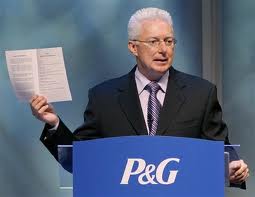
A.G Lafley is justifiably famous for taking over Procter & Gamble (P&G) and converting an insular company into a customer-centric, outward-looking culture known for a string of successful innovations. When Lafley became CEO in 2000, innovation was driven by thousands of in-house R&D designers, researchers, and engineers. They created neat stuff and “pushed” it to customers. Partially as a result, P&G’s success rate with new products and brands hovered around 15%. The R&D teams focused internally; only about 10% of new products came from outside the company.
Lafley essentially turned the company inside-out by putting the customer at the head of the innovation process. P&G called it Connect + Develop and emphasized collaboration with other departments, customers, and even outside research organizations. Lafley changed the culture from “not invented here” to “proudly found elsewhere”. P&G signed more than 1,000 collaborative agreements with outside organizations. It was a fundamental cultural change and the results were spectacular. According to a report from A.T. Kearney, “During Lafley’s tenure, sales doubled, profits quadrupled, and the company’s market value increased by more than $100 billion”.
Now Lafley has written a book, Playing to Win: How Strategy Really Works, with Roger Martin, the Dean of the Rotman School of Management at the Univeristy of Toronto. Martin was Lafley’s “principal external strategy advisor”. In addition to Martin, Lafley built a brain trust of outside thinkers including designers and business professors. The eclectic nature of the group created many different “idea collisions” that generated process innovations as well as product innovations.
I’m sure that I’ll write a lot about the book in the future but it’s not quite out yet. It debuts in February. Today, I’m depending on the report from A.T. Kearney and a lengthy review from The Economist. One of the key insights is that P&G followed a strategy composed of five elements, each designed to help managers make the right decisions. These are:
It’s a good story and an intriguing look at strategy. Unfortunately, it doesn’t have an entirely happy ending. The Economist reports that P&G has “stumbled badly” since Lafley left in 2009. Similarly, Martin’s consulting firm “got into financial difficulty and has been sold at a discount.” Still, the questions are relevant to any company’s strategy and the story is intriguing. I’ll report more soon.

Can we be part of the strategy?
The CEO is clearly the most important executive when it comes to creating and implementing organizational strategy. Who’s the second most important executive for strategy?
The standard answer is probably the Chief Operation Officer — especially in terms of carrying out the strategy. But I’m starting to think that the COO is only the third or fourth most important strategic officer. So, who’s number 2? I’m leaning towards the head of Human Resources. Let’s call him or her the Chief Human Resources Officer or CHRO.
I’m leaning toward the CHRO because I’ve always believed that the soft stuff is hard. It’s not easy to get your culture right or to motivate employees for the long haul. It is all too easy to get your strategy crosswise with your culture. As I’ve noted before , when it’s culture versus strategy, culture always wins.
Similarly, I’ve never seen a company falter because they couldn’t find enough “numbers guys”. Our B-schools just keep churning them out. On the other hand, I have seen companies falter because they couldn’t find good communicators and motivators. Understanding human behavior is much more difficult than understanding the numbers. While we can teach people the “soft arts,” it doesn’t seem to be a popular specialty at university.
What’s really pushing me toward the CHRO as strategy leader is Scott Keller and Colin Price’s book, Beyond Performance: How Great Organizations Build Ultimate Competitive Advantage. (Click here for the book or here for a white paper). Keller and Price argue that too many companies pay close attention to performance (“the numbers”) but not nearly enough attention to organizational health. Their “…central message is that focusing on organizational health — the ability of your organization to align, execute, and renew itself faster than the competition — is just as important as focusing on the traditional drivers of business performance.” This has everything to do with the “people-oriented aspects of leading an organization.” In my mind, that means the CHRO better be intimately involved.
Keller and Price present a lot of statistical evidence to buttress their case. (They are McKinsey guys, after all). There is a distinct correlation between organizational health and organizational performance. They also present five “frames” for viewing both health and performance during transformation change: 1) Aspire; 2) Assess; 3) Architect; 4) Act; 5) Advance. I’ll write more about these in the future but the bottom line is that you need to use these frames to view both performance and health to develop a sustainable, high performance organization.
While I think the CRHO could and should be a strategy leader, in my experience, it doesn’t happen very often. I’ve seen HR organizations launch very interesting programs but, too often, the programs exist in their own right rather than as strategic enablers. They don’t impede the strategy but they don’t help it either. I also see the numbers guys set the strategy and then turn to the CHRO and say, in effect, “OK, here’s the strategy, now get us the people we need.” (In technology, this happens to CIOs all the time). To be effective, the CHRO really needs to be at the strategy table.
Why wouldn’t the CHRO be invited to the strategy table? Perhaps because they understand the soft stuff but not the business. I’ve seen CHROs (and CIOs) make naive comments in strategy meetings, showing that they clearly don’t understand the business. The result is a bunch of numbers guys rolling their eyeballs and looking vaguely embarrassed. Numbers guys need to learn more about the soft stuff. By the same token, CHROs (and their staffs) need to learn more about the performance side of the business. Perhaps then, they can truly become strategy leaders.

My skeptical spectacles are on high alert.
Manti Te’o is a linebacker for Notre Dame and widely regarded as one of the best players in college football. During the past season, a story emerged that his girlfriend had leukemia and lingered near death. She died just before a big Notre Dame game. But Te’o was loyal to his teammates and played through his heartbreak to help Notre Dame win the game and go undefeated in the regular season.
It’s a great story. Unfortunately, it’s not true. The girlfriend never existed. The blogosphere has been obsessing over whether Te’o is the perpetrator or the victim of the hoax. I have a different question: why did we believe the story in the first place?
I think we were fooled by Te’o for the same reasons we were fooled by Lance Armstrong, Greg Mortenson, and Bernie Madoff. We were active participants in the deception. We wanted to believe their stories. I’m an avid cyclist and I certainly wanted to believe Armstrong’s story. What a great story it was. It gave us faith in our human ability to overcome great obstacles. So I fell prey to confirmation bias. Consciously and subconsciously, I attended to evidence that confirmed my beliefs. I ignored evidence that contradicted them. When Armstrong finally came clean, I felt he cheated me. I also realized I cheated myself. I had a double dose of regret.
Of course, there are people whose marvelous stories don’t need embellishment. Mother Teresa certainly comes to mind. She’s already beatified and seems well on her way to sainthood. Nelson Mandela was probably politically expedient from time to time but, by and large, the legend fits the man. Jackie Robinson wasn’t a perfect man but he really did do what he was famous for. (Hmm … why am I having difficulty identifying a contemporary white male to put in this category?)
So, how do we distinguish between those who claim to be saintly and those who actually are? Here’s my proposed Saintliness Rule. When a story makes someone sound saintly, put on your skeptical spectacles. Use your filters that help you suspend belief (as opposed to disbelief). Be patient, review the evidence, be doubtful. Be skeptical but not cynical. After all, there really are some saints out there.


