Strategy. Innovation. Brand.
Could Romney Win But Lose?
 Every four years, my friends from outside the United States ask me about the weirdness of American presidential elections. How could George Bush get fewer votes than Al Gore in 2000 and yet win the election? (My namesake, Grover Cleveland, did it too).
The answer is that we treat elections like boxing matches (in more ways than one). Who wins a boxing match? Whoever wins the most rounds. Let’s say it’s Joe versus Bob for three rounds. Joe hits Bob 27 times in the first round while Bob responds weakly with only 10 hits. Joe wins the round. In the second round, Bob hits Joe 8 times and Joe responds with only 7 punches. Bob wins the round. In the third round, Bob strikes 9 times; Joe only 5. Bob wins the round. So, who wins the match? Even though Joe has hit Bob 39 times and Bob has hit Joe only 27 times, Bob wins the match. He’s won two of the three rounds. Lenox Lewis famously lost a title match about a dozen years ago in exactly this fashion.
Our presidential election functions essentially the same way. It’s not one national election but, rather, 50 state elections (weighted by population). Why? Because the states existed before the nation and they jealously guard their privileges.
I’m starting to believe that Mitt Romney could be the next Al Gore, winning the popular vote but losing the election. The red states seem to support Romney by a wide margin. Conversely, the blue states seem to support Obama by a narrow margin. In general, the blue states are more densely populated than the red states. Indeed, this is shaping up to be an urban versus rural election. That also means that Obama could win the blue states by a narrow margin and lose the red states by a wide margin. If the math works out right (or wrong), Obama could very well win the Electoral College, while losing the popular vote. The whole election seems to come down to two states: Ohio and Colorado.
There are still 11 days left until the election — that’s long time in politics. It’s interesting to speculate but anything could happen. However, if Obama loses but wins, remember that you heard it here first.
Creativity: Learning to See

Can you see me?
Jorge Luis Borges once wrote a story about a unicorn that no one saw. The unicorn grazed widely in the town where it lived and made no effort to hide itself. No one saw the unicorn because no one expected to see a unicorn. We see what we know, Borges seems to say. If we don’t know that something exists, we can’t possibly see it. It’s invisible.
I recently bought a car and decided to get it in flamenco red. I liked the color but I also thought it was unique. I hadn’t seen any flamenco red cars. As soon as I ordered the car, I started seeing flamenco red cars everywhere I looked. I hadn’t seen them before because I didn’t know they existed.
If we only see what we know, we’re going to miss a lot of reality. Worse, we’re going to miss many opportunities to be more creative. If we believe that politicians are liars, then every time we see a newspaper article about a lying politician, we’ll see it and register it. If we see an article about a politician telling the truth, we may just miss it altogether. We didn’t know that such a species existed. We’re missing a chunk of reality and an opportunity to open our minds and see and do things differently.
How do you learn to see what you don’t typically see? Here are some pointers:
- Ask your spouse — he or she will see the world somewhat differently. Ask him/her what you’re missing. Suellen says I never see plants. On the other hand, she never sees ’57 Chevys.
- Make a point of it — when you drive to work tomorrow, make a point of seeing something different. You’ll be surprised what you’ve been missing.
- Compare pictures — look at a picture and write down what you see. Then ask a friend (or friends) to do the same. Then compare what you’ve written. In Thinking Fast and Slow, Daniel Kahneman writes that Chinese student see pictures very differently than American students. I’ll write more about that soon.
- Learn to draw — this really gets you to see.
As you learn to see more fully, you should also get more creative. You’ll see connections — and opportunities — that you might have missed before. I sometimes wonder if Jorge Luis Borges was so creative precisely because he sees the world so differently. After all, he was blind.
See more in the video.
Innovation: What’s Your Risk Profile?

Need a spreadsheet?
Quick. What’s your risk profile? Do you like to take risks in business? If you do, you’ll probably seek and consume information in very different ways than your colleagues who are more risk averse. That can be a huge obstacle to innovation.
I often ask my clients to self-assess their appetite for risk on a scale of 1 to 6. People who are very averse to risk give themselves a “1”. People who love taking risks give themselves a “6”. In most cases, my clients distribute themselves along a more-or-less normal curve — a few 1s and 6s and many more 3s and 4s. To innovate successfully, you’ll need people in every category. If you have only 1s, you’ll never venture anything. If you have only 6s, you’ll take far too many risks for your own good.
The issue is that people with different risk profiles also have different information needs. That can stifle communication and that, in turn, can stifle innovation. People who are generally risk averse (in a business sense), want much more information than those who are risk oriented. People who are 1s often want very detailed business cases before making a decision. They want to identify every possible risk in the proposed venture and have contingency plans ready. They also like detailed spreadsheets; lots of quantitative data makes them feel comfortable.
Risk-oriented people, on the other hand, are quite comfortable with less information. They believe that it’s impossible to predict the future. A detailed spreadsheet is no better at predicting the future than a rough-and-ready guess. Further, you can’t control every variable. So, why bother creating detailed spreadsheets and exhaustive business plans? You have to dive in and experiment to learn what will work and what won’t.
To innovate successfully, you need both risk-oriented and risk-averse individuals. They see the world differently and that’s good. Your risk-oriented colleagues can help you spot new opportunities. Your risk-averse colleagues can help you avoid stupid mistakes. The trouble is that the two types of colleagues don’t know how to talk to each other effectively. They have different information needs that are very deeply ingrained and will probably never change. As a leader, you’ll need to step in and serve as an interpreter between the two groups. By doing so, you’ll hear both sides, get a balanced view, and pick those innovations that are most likely to work.
Innovation: The Cynical Rebound and the Grateful No
You’ve told your employees you want more innovation. You’ve sponsored brainstorming sessions. You’ve sponsored mixers to break  down departmental barriers. You’ve offered prizes. You’ve put up motivational posters. You’ve created t-shirts and coffee mugs with all the right slogans.
So what do your employees do? They offer up good ideas. Yikes! Now what? If your company is like most, your employees have lots of ideas on how to improve your company, your products, and your services. Give them a little encouragement to open up and share their thoughts, and you’ll get a boatload of suggestions.
What could be wrong with that? Well…. unless you plan ahead, you could create a company full of cynics. Your employees will almost certainly come up with too many ideas. You won’t be able to process them all much less implement them all. As a result, you could easily cause the dreaded Cynical Rebound.
The Cynical Rebound is the natural (and universal) reaction that occurs when one is asked for suggestions and then ignored. You can hear the frustration in phrases like, “If you’re not going to listen to me, then why did you ask my opinion?” “They said they wanted fresh ideas but I guess they didn’t want mine.” “I offered up a good idea and never heard anything. That’s the last time I’ll do that.” If allowed to spread, the Cynical Rebound will bring all of your innovation processes to a screeching halt.
How to avoid the Cynical Rebound? Before you begin an innovation campaign, be sure to set expectations appropriately. Let everyone in the company know that there probably will be too many ideas. You won’t have the bandwidth to pursue all good ideas immediately. You’ll need to stockpile some for future consideration. The keep the communication lines open. One of the major goals of the Innovation Free Port is to communicate the status of good ideas as they wend their way through the process. If an idea is stockpiled, be sure to let everyone know– especially the originator.
You can also prevent the Cynical Rebound by using the Grateful No. You’ll need to turn down some ideas. Just do it gracefully. The Grateful No starts by separating the person from the idea. The person is wonderful; the idea less so. Express your gratitude to the person and encourage them to continue to offer new ideas. Then explain — clearly and simply — why you’re not going to pursue the idea in the near term. You need to give a real reason; it can’t be fluff. Continue the explanation until you see the person nodding her head. Then stop — you’ve got the sale so quit selling.
The Grateful No closes the loop. The originator knows that you’ve seriously considered the idea but can’t act on it now. She also knows the reason — which could help her formulate better ideas in the future.
Once it gets started, the Cynical Rebound is very hard to stop. So plan ahead. Set expectations appropriately and make sure you have a working Free Port before launching an innovation initiative. Be sure that your managers are trained in the Grateful No technique. A little planning could save you a lot of pain.
The Father of Modern Art Comes to My Town
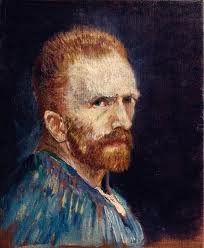
Come see me or I’ll cut my ear off.
A few weeks ago, Barry and Mitt came to my town for an epic smack down. Today, Vincent Van Gogh arrived for an epic exhibition. Vinny (as we call him out West) is represented in an 80-piece exhibit that has to be the best collection of Van Goghs ever assembled in America. It’s at the Denver Art Museum until January 20, 2013. Interestingly, it’s not traveling anywhere else. So you either see it here or you don’t see it. Luckily for you, Suellen and I are taking reservations for our spare bedroom.
Van Gogh was to art what the Protestant Reformation was to religion. The Reformation said that you don’t have to ask someone else to read the Bible for you. You can read it yourself and form your own interpretation. Van Gogh said that a work of art doesn’t have to simply mirror reality. Art stands apart. It creates its own reality. You can create your own interpretation You can paint what you know, not just what you see.
It’s well known that Van Gogh broke the classic rules. He also broke the contemporary rules (impressionism, romanticism) and created something entirely new. In some ways, the mere fact of breaking the rules so thoroughly was more important than what he created. By breaking the rules, he liberated subsequent generations to go even farther. The art word is still reverberating. (I’m guessing, though, that the art world will re-adopt classic rules in the next few decades. When there are no rules, then adopting rules is radical and innovative).
So, how good is the show? It’s fabulous. But don’t take my word for it. Here’s what the Wall Street Journal wrote. Here’s what the Denver Post wrote. Here’s what the Yale Univeristy Press wrote. There’s a lot more press coming. Before the crowds descend, make your plans to visit Denver. Be sure to let us know when you’ll be here — the Hôtel du Chateau White may just be available.
My Social Media


