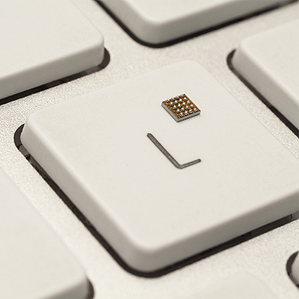
Would you swallow it?
In The Social Animal, David Brooks writes that, “We are living in the middle of a revolution in consciousness. Over the past few years, geneticists, neuroscientists … and others have made great strides in understanding the building blocks of human flourishing. And a core finding … is that we are not primarily the products of our conscious thinking. We are primarily the products of thinking that happens below the level of awareness.”
Further, “If the conscious mind is like a general atop a platform who sees the world from a distance and analyzes things linearly and linguistically, the unconscious mind is like a million little scouts. The scouts careen across the landscape, sending back a constant flow of signals and generating instant responses.”
Now here’s how Tim Simonite, writing in Technology Review, describes a two-millimeter square computer (pictured): “If the Internet is to reach everywhere – from the pills you swallow to the shoes on your feet – the computers will need to get a whole lot smaller. A new microchip that is two millimeters square and contains almost all the components of a tiny functioning computer is a promising start.”
Simonite describes the technical challenges of creating a swallowable computer the size of an ant. I won’t try to summarize the technical issues. For me, the bigger issue is simple: don’t swallowable, ant-sized computers mimic a “million little scouts?” Are we building a giant brain here? If so, what are we going to do with it? Does the NSA get to run it?
 Lucy Kellaway has an excellent column in the Financial Times in which she identifies the top 10 failed management fads. (Click
 My sister has a Ph.D. in biology. For her dissertation, she randomly divided fruit flies into two groups and treated them exactly the same except for one variable. She introduced a specific chemical to one group but not the other. Then she followed the effects through multiple generations. I don’t remember what she discovered but her method allowed her to conclusively link cause to effect.
 The first thing you’ll notice about these questions is that they’re all in the past tense. As we know from studying rhetoric,


Recent Comments