

It’s a metaphor.
Most companies pay a lot of attention to their formal messages. They’ll work for hours writing and re-writing slogans. They’ll spend days trying to perfect their mission statement. They’ll work hard to get their press release just right.
Metaphors, on the other hand, attract very little formal attention or review. Ask an employee what it’s like to work for a company and they’ll often use metaphors in their response. These metaphors typically are not carefully crafted. They occur naturally, without forethought or guile. Precisely for this reason, they provide an excellent window into what the company really thinks.
If you’re thinking of buying from or working for a company, pay particular attention to the metaphors that employees use. The metaphors will give you insights into the company that you’ll never glean from the formal messages.
If you’re an executive of the company, you also need to pay attention. Your employees may use metaphors that undercut the company’s position. Worse, they may have acquired those metaphors from you. Listen to the metaphors and decide whether you need to change them. If you do, you’ll need some new stories.
Learn more in the video.

It’s complicated.
Your friend, Mary, avidly and vocally supports a national flat tax. Or maybe she’s convinced that free trade is the only sensible way to stimulate the world economy. Or maybe she actively supports more government programs to ensure equality of opportunity.
Let’s also assume that you disagree with Mary. You’d like her to see your side. But she’s so convinced that she’s right — and everybody else is wrong — that it’s difficult to have a conversation with her. Your attempts at dialogue just devolve into long-winded diatribes.
So how do you move Mary? Here are two different communication strategies:
If you pursue Strategy 1, Mary will simply launch into her “pre-recorded” sound bites and positions. Strategy 1 does not require Mary to think. It merely requires her to repeat. She continues to convince herself. As a result, Mary’s position will likely become even more extreme.
Strategy 2, on the other hand, requires Mary to think through a variety of complicated, real-world issues. A common feature of extreme political positions is that they’re over-simplified. By requiring Mary to think through complicated issues, Strategy 2 often reveals weaknesses in the logic. It’s not so simple as it seemed. As a result, Mary’s position often becomes more moderate and more nuanced.
The effectiveness of Strategy 2 derives from the “illusion of explanatory depth”. In their article on the phenomenon (click here), Leonid Rozenblit and Frank Keil explain that, “People feel they understand complex phenomena with far greater precision, coherence, and depth than they really do; they are subject to an illusion—an illusion of explanatory depth.” When you ask people how their ideas would actually work, they start to bump into the limits of their illusion. They don’t understand it nearly as well as they thought. As their explanation falters, so does the certitude of their position.
In this final week of the presidential campaign, many people are stating extreme positions. If you want to have a substantive discussion with another person — as opposed to a battle of sound bites — don’t ask why they believe something. Rather, ask them how it works.
I used to be proud of my ability to focus. When I was a software executive, I could identify my top priorities for the day and focus on
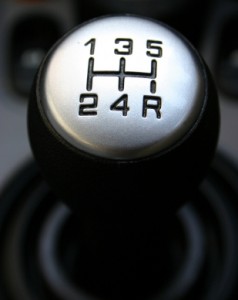
Geared up?
getting them done. That sometimes meant that I turned off my phone and ignored my e-mail. I had an assistant who could run interference for me. Sometimes, I hid in an office where my colleagues wouldn’t expect to find me. I could focus for several hours at a time — maybe even an entire day — and just get stuff done.
Now that I’m a consultant with multiple clients, I’m constantly shifting from one topic or task to another. I can’t hide from my boss to get stuff down. I am the boss. I can’t very well hide from my clients. If they can’t find me, they don’t pay me. I feel like I randomly shift from one topic to another, from one client to another, from one task to another. Like an old car, I’m worried that the constant shifting will strip my gears.
What to do? Here’s what I’ve figured out. I’d love to hear your suggestions as well.
 Every four years, my friends from outside the United States ask me about the weirdness of American presidential elections. How could George Bush get fewer votes than Al Gore in 2000 and yet win the election? (My namesake, Grover Cleveland, did it too).
The answer is that we treat elections like boxing matches (in more ways than one). Who wins a boxing match? Whoever wins the most rounds. Let’s say it’s Joe versus Bob for three rounds. Joe hits Bob 27 times in the first round while Bob responds weakly with only 10 hits. Joe wins the round. In the second round, Bob hits Joe 8 times and Joe responds with only 7 punches. Bob wins the round. In the third round, Bob strikes 9 times; Joe only 5. Bob wins the round. So, who wins the match? Even though Joe has hit Bob 39 times and Bob has hit Joe only 27 times, Bob wins the match. He’s won two of the three rounds. Lenox Lewis famously lost a title match about a dozen years ago in exactly this fashion.
Our presidential election functions essentially the same way. It’s not one national election but, rather, 50 state elections (weighted by population). Why? Because the states existed before the nation and they jealously guard their privileges.
I’m starting to believe that Mitt Romney could be the next Al Gore, winning the popular vote but losing the election. The red states seem to support Romney by a wide margin. Conversely, the blue states seem to support Obama by a narrow margin. In general, the blue states are more densely populated than the red states. Indeed, this is shaping up to be an urban versus rural election. That also means that Obama could win the blue states by a narrow margin and lose the red states by a wide margin. If the math works out right (or wrong), Obama could very well win the Electoral College, while losing the popular vote. The whole election seems to come down to two states: Ohio and Colorado.
There are still 11 days left until the election — that’s long time in politics. It’s interesting to speculate but anything could happen. However, if Obama loses but wins, remember that you heard it here first.

Chevy. For the young set.
Once upon a time, General Motors had five major brands. Why five? Because there were five decades in the car buying experience. GM had a car for every need and every age.
Back in the day (my Dad’s day), everyone understood how to buy GM brands. Chevrolet was for young couples in their twenties, just starting out in life. In your thirties, you traded up to a Pontiac — a little nicer, not quite so bare bones. Oldsmobile was the choice for forty-somethings — a good middle of the road brand. In your fifties, you opted for a Buick — more luxury, near top-of-the-line. When you reached your sixties (and beyond), you wanted to signal that you had made it — so you bought a Cadillac.
In the late 80s, Tom Wolfe’s Bonfire of the Vanities had a good line comparing a European brand with GM. One of Wolfe’s characters talks about getting rich and buying a Mercedes. Another character responds, “Oh, a Mercedes is just what a Buick used to be.” I recently bought a large Volvo sedan. I like it a lot but I also think, “Oh, it’s just a Swedish Cadillac”.
So, what happened to GM? They stopped building brands and started building cars. Instead of clearly differentiating their brands, they decided to aim for manufacturing efficiency by consolidating platforms, parts, and styling. They may have saved some money on the manufacturing line but they wound up producing indistinguishable cars. Whey would I pay more for a Buick when it looks just like a Chevy? GM reached the nadir with the Cadillac Cimarron — a re-badged Chevy Citation. A GM engineer was asked, “What’s the difference between a Citation and a Cimarron?” He famously replied, “About $5,000”.
What’s the lesson here? Brands belong to buyers, not sellers. GM thought they owned the brands and could treat them to a dose of industrial efficiency. The move made sense from a manufacturing perspective but not from a brand perspective. Once the brands lost their distinction, they also lost their markets.
It’s probably time to review your brands. Don’t review them based on features or functions — that’s the way sellers think. Rather, review your brands based on which markets they appeal to. Are those markets really different from each other? If they are, then keep accentuating the brand differences. If they all appeal to essentially the same market, however, you may want to consolidate your brands. There’s no point keeping five brands around if potential buyers can’t tell them apart.


